Projects
[Vibe Coding] Real-Time ATC Transcription for Pilots
Visualizing Air Traffic Communication in Real Time
ROLE
Designer/User
TOOLS
Figma, Claude Code
WHAT MAKES ME WANT TO START THIS PROJECT?

On February 25, 2025, a near-tragic runway incursion occurred at Chicago Midway Airport involving Flexjet Flight 560 (a Challenger 350) and Southwest Flight 2504 (a Boeing 737-800). Despite ATC’s instruction to “hold short” of Runway 31C, the Flexjet crew misheard and mistakenly crossed the active runway without clearance.
This serious communication breakdown between ATC and experienced pilots highlights how easily misunderstandings can escalate into dangerous situations. If such errors can occur among professionals, the risks are even greater for student pilots or less experienced aviators—making clear, accessible communication tools essential for aviation safety.
Overview
As both a licensed pilot and a non-native English speaker, I’ve personally experienced one of the biggest challenges in aviation: ATC (Air Traffic Control) communication. Fast speech, aviation-specific jargon, and the pressure of flying can make it difficult to catch every instruction. Missing or mishearing critical instructions can compromise situational awareness, safety, and pilot confidence.
This case study explores the design of a real-time ATC transcription tool—a system that listens to ATC transmissions and instantly provides text transcriptions for pilots in the cockpit.
The Problem
Pilots often struggle to fully understand ATC communications due to speed, accent, jargon, or nervousness.
In high workload environments, even experienced pilots can miss transmissions.
Current avionics systems provide no text backup—only audio.
A misheard instruction (e.g., wrong altitude or heading) can lead to dangerous outcomes.
HMW help pilots improve comprehension and confidence in ATC communications through accessible, real-time support?
The Million Dollar Question
Interviewing Pilots & Flight Instructors
Pilot Interviews (5 private pilots, 2 CFIs): to understand real-world ATC struggles.
Flight Observation: listening in on tower communications at a local Class C airport.
Competitive Benchmarking: looked at speech-to-text tools (Otter.ai, Microsoft Azure STT, LiveATC), but none were optimized for aviation.
Personas

Persona 1: Rodrigo
International Student Pilot
28 years old, Spanish native speaker.
Struggles with fast ATC speech.
Goal: Increase confidence during solo flights.
Pain: Often needs to request “say again,” feels embarrassed.

Persona 2: Sarah
Private Pilot, Busy Airspace
35 years old, English native speaker.
Goal: Reduce workload in busy Class B airspace.
Pain: Misses instructions when multitasking.
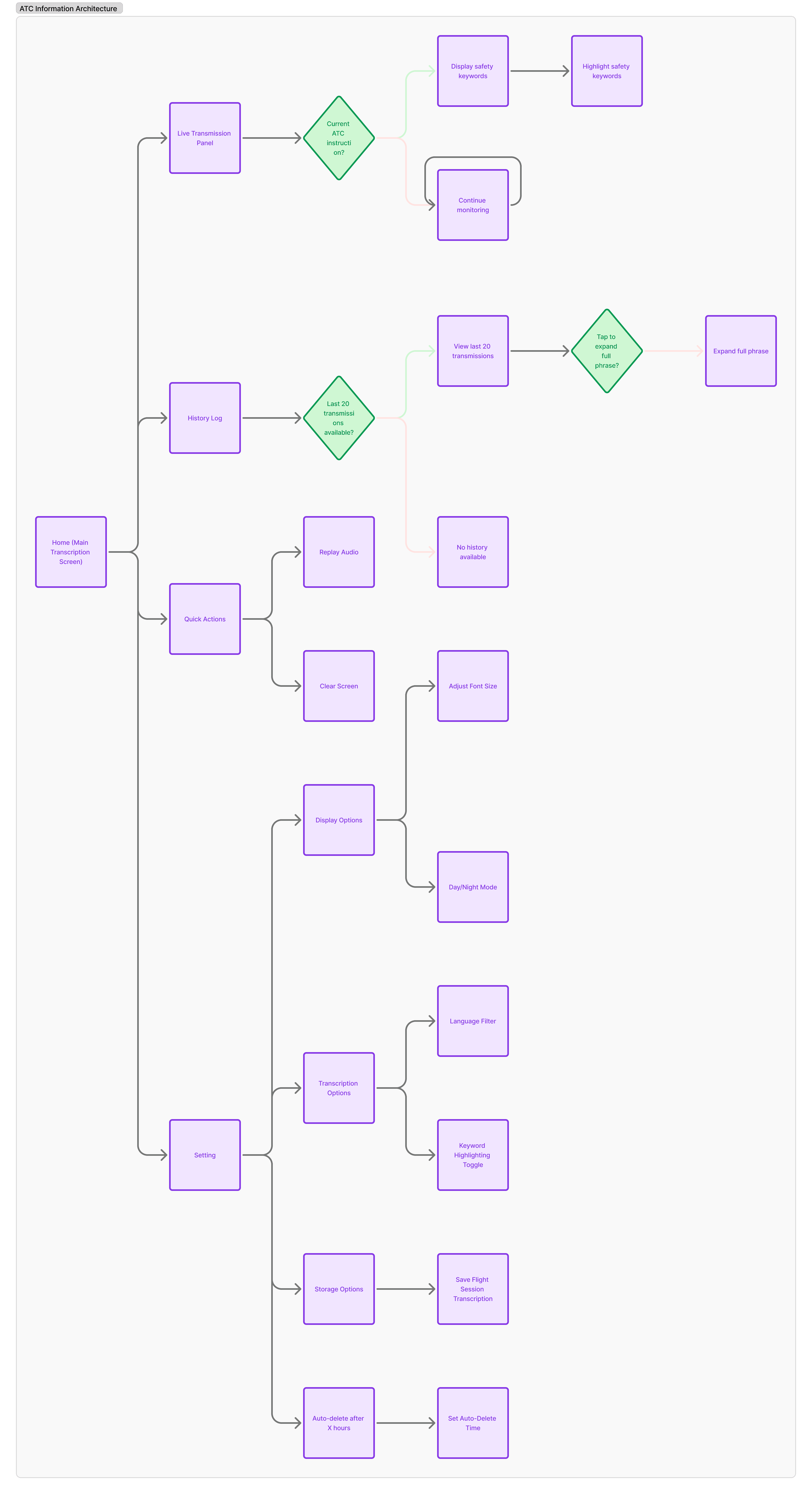
User Flow
Initial Sketches
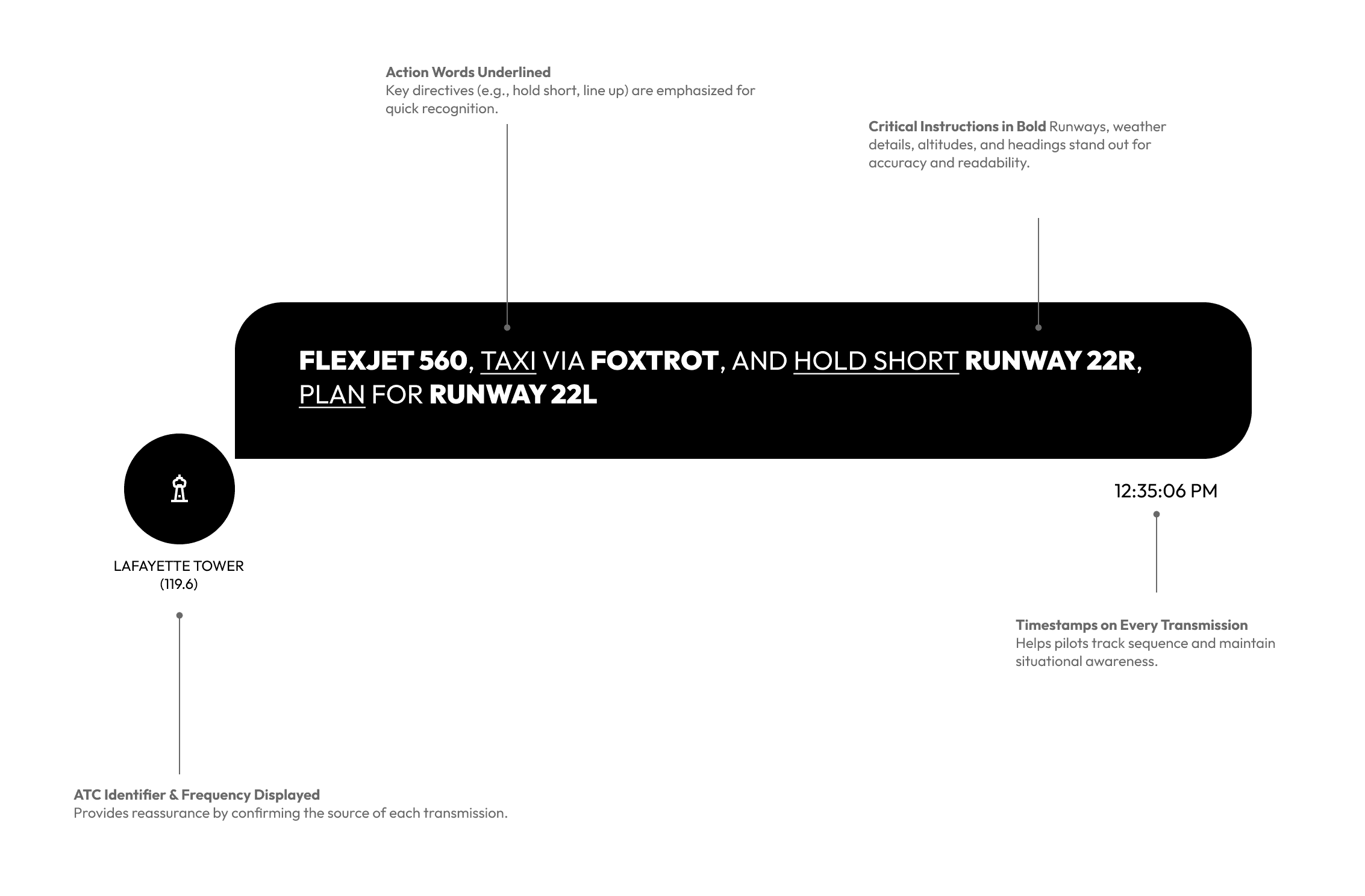
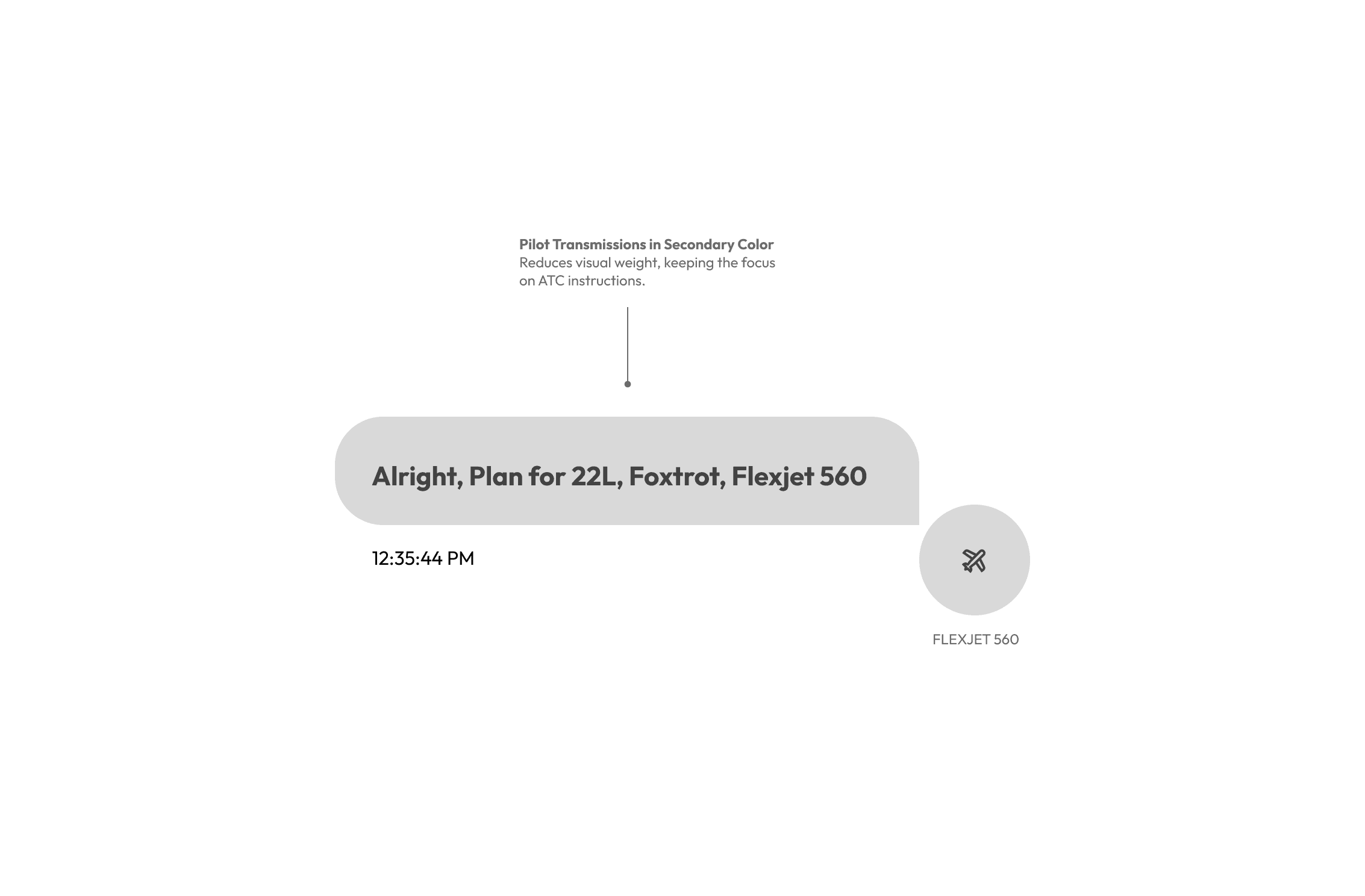
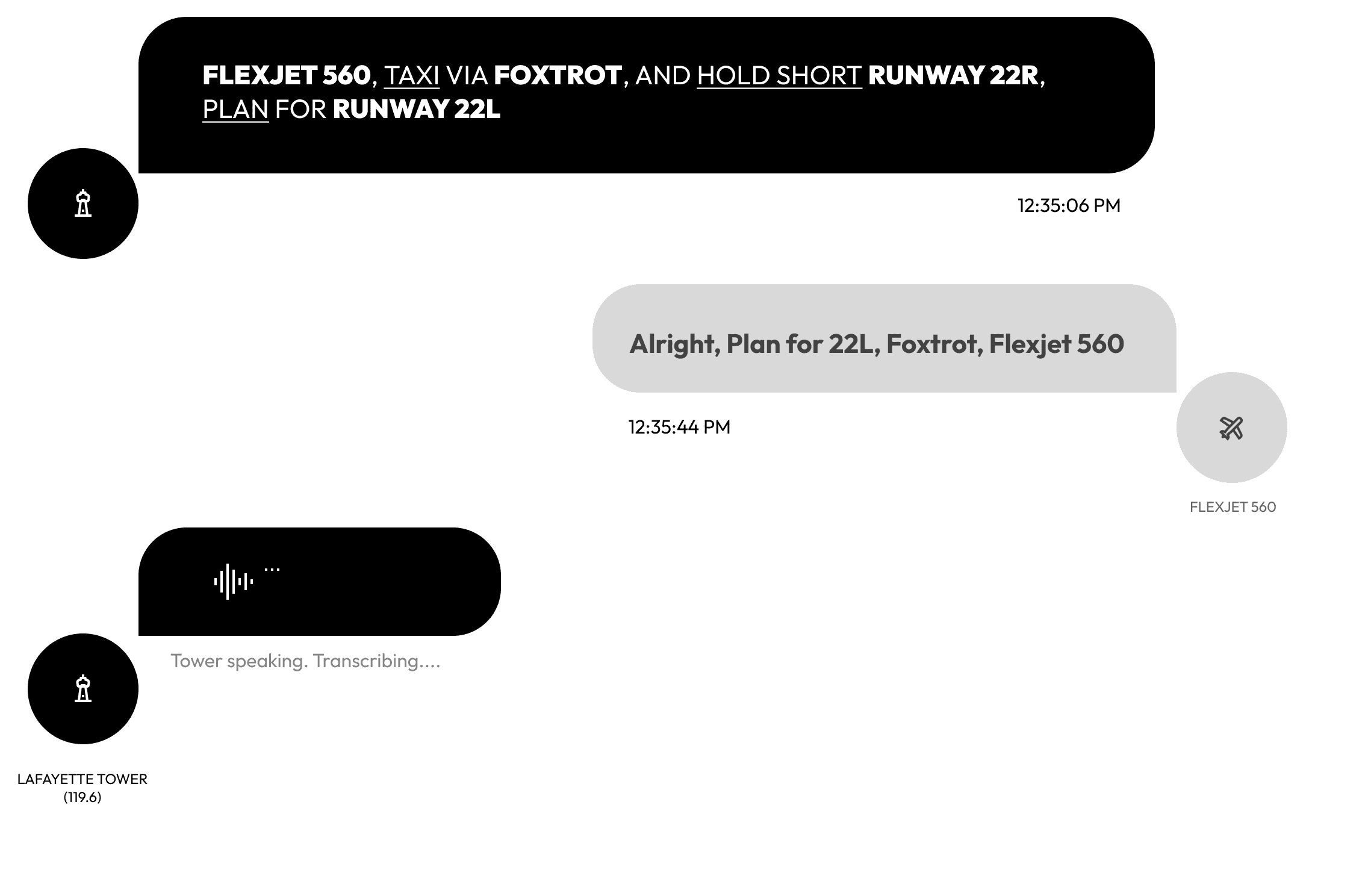
Usability Testing in Simulated Flight Conditions
To evaluate the effectiveness of real-time transcription in a realistic environment, I conducted a usability test with four pilots during a simulator session. The prototype was deployed on an iPad, where pilots were asked to respond to ATC instructions with transcription support enabled. This setup allowed us to observe how the tool integrates into actual cockpit workflows under time-sensitive conditions.
Setup
4 pilots participated in a simulator-based test
Prototype deployed on iPad
Task: Respond to ATC instructions using real-time transcription support
Improved Confidence & Faster Comprehension
Results
100% of pilots reported increased confidence in understanding ATC instructions
Non-native English speakers noted significantly faster comprehension
Transcription helped “decode” complex or rapid instructions in real time
Actionable Feedback for Iteration
Feedback
Increase font size for better in-flight readability
Store at least the last 20 transmissions for quick reference
Add voice playback of the most recent instruction as a backup
Next Steps
This project explores how AI-powered transcription can better support pilots by integrating with existing aviation tools and improving accuracy in complex communication environments. Future directions focus on enhancing ecosystem compatibility, domain-specific intelligence, and real-world validation.
Explore integration with ForeFlight and Garmin Pilot to embed transcription directly into pilot workflows
Leverage AI-driven glossary identification to recognize aviation terminology and improve transcription accuracy
Validate performance in IFR scenarios and untowered airports where communication is dense and fast-paced
Projects